Writing an SBIR proposal feels like you're trying to please two completely different people at the same time. It’s a classic two-front war. On one shoulder, you have the hyper-skeptical PhD, the technical reviewer who lives and breathes the science. Think Spock from Star Trek—they want to see true innovation, novel algorithms, and a work plan so detailed it could bring a tear to a project manager's eye. On the other shoulder, you have the pragmatic VC-type, the commercial reviewer. Think Mark Cuban on Shark Tank. They couldn't care less about your p-values; they want to know the TAM, the go-to-market strategy, and how this thing makes money.
Most founders write for one and hope the other gets it. It’s a tough needle to thread, which is why only about 15% of them get funded. But what if you could write one story that nails it for both? What if you could build the One Proposal to Rule Them All?
Nailing this is more than just a grant-writing hack; it's about mastering a core competency for any deep tech founder: translating profound technical depth into a compelling commercial narrative. Let's build the playbook.
The Prize: Why We're Playing This High-Stakes Game
So, you're thinking, "15%? Those are some tough odds." And you'd be right. I get it, that sounds like trying to hit a womp rat in your T-16. The Small Business Innovation Research (SBIR) program is one of the most competitive funding sources on the planet. But let's look at what's actually on the table. We’re not talking about a small academic grant to keep the lights on for a semester. We’re talking about rocket fuel.
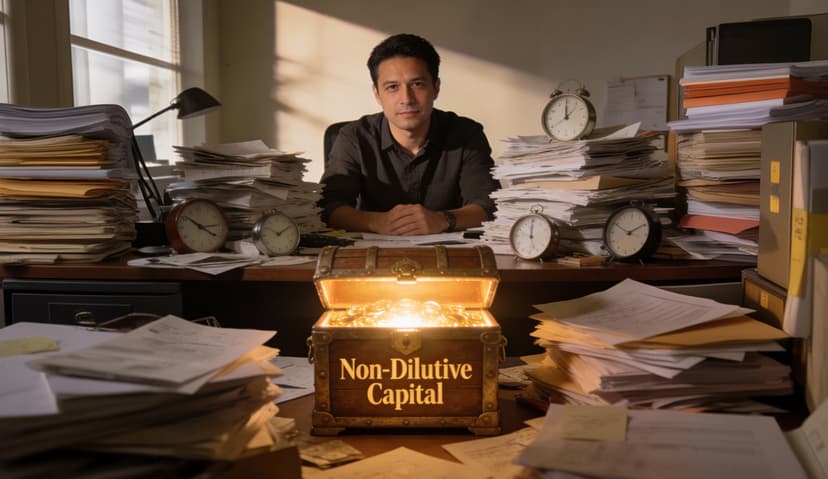
Phase I is designed for feasibility and can net you anywhere from $50,000 to $275,000 in non-dilutive capital. If you prove out your concept, Phase II—the R&D and prototype phase—unlocks a much bigger treasure chest, often between $750,000 and $1.8 million. All of this, without giving up a single point of equity.
Think of it like leveling up in a video game. Level 1 is Phase I, where you prove your concept and collect a cool $50k - $275k. Beat that level, and you unlock Level 2: Phase II, the prototype-building boss battle that comes with a $750k - $1.8M prize. The final boss, Level 3, is full commercialization, powered by private or government follow-on funding.
[Image: The "Level Up" screen from a classic RPG, showing a character gaining stats.]
And if you’re thinking this game is only for seasoned pros, think again. A recent analysis found that 32% of 2025 NASA SBIR awardees were first-time recipients. The game is hard, but it’s winnable, even for rookies. Okay, we know why we're here. Now let's dive into who we need to convince, and how their brains work.
Act I: Winning Over the Spock-Brain (The Technical Reviewer)
Imagine a hyper-skeptical PhD with a "prove it" attitude. This is your technical reviewer. They are the gatekeepers of scientific rigor, and their primary question is: "Is this technically sound, and is it truly innovative?" They’ve seen it all, and they’re not impressed by buzzwords. They want to see your brain on paper.
[Image: Spock from Star Trek raising an eyebrow with the caption "Fascinating... but is it feasible?"]
Your proposal is explicitly judged on its “Intellectual/Technical Merit.” This means they are looking for what one expert calls “true innovation, not just incremental improvements.” If your solution is just a 10% better version of an existing product, you’re playing the wrong game. You need to be proposing a fundamental shift, a novel approach that creates a new category or makes the old one obsolete.
Speaking Their Language: Rigor and Feasibility
To win over this reviewer, you need to speak their language. That means detailing a credible and feasible work plan with measurable milestones and clear technical objectives. I've seen so many brilliant ideas stumble here because the "how" wasn't as precise as the "what." You need to break down your R&D process into logical, sequential steps. What experiments will you run? What are the specific technical questions you need to answer? What are your quantitative success criteria for each objective?
This is also where you showcase your team's credentials. Your proposal needs to scream that your Principal Investigator (PI) and the supporting team are the Avengers for this exact problem. Don't just list their degrees; highlight past successes, relevant publications, and prior R&D projects that prove they have the technical receipts to back up their claims. The reviewer needs to walk away thinking, "Fascinating. Not only is the idea brilliant, but this is unequivocally the right team to pull it off."
Great, so your technical chops are undeniable. But remember that other shoulder-angel? The one who thinks in spreadsheets? Let's talk to them.
Act II: Winning Over the Shark (The Commercial Reviewer)
This is where you put on your CEO hat, not just your CTO one. The commercial reviewer operates on a different frequency. Their core question is simple: "So what? Who cares, and who will pay for it?" They are assessing your proposal on its “Broader Impacts/Commercial Potential,” and for many agencies, this section is the tie-breaker. It's often the weakest link in proposals from technically-focused teams.
[Image: A screenshot of Mark Cuban from Shark Tank looking skeptical with the caption, "And for that reason... I'm out."]
Your commercialization plan is the bridge from your lab to the real world. It cannot be an afterthought. It demands the same level of rigor and data as your technical plan. You need to make what one grant writing firm calls “specific, data-heavy assertions on market potential and revenue.”
Show Me the Numbers
Vague statements like "the market is large and growing" are the equivalent of telling a Shark "we're pre-revenue" and expecting a high-five. It’s a one-way ticket to "I'm out." You need to quantify everything. What is the Total Addressable Market (TAM)? Who are your specific target customers? What is your evidence that they have the pain point you’re solving and are willing to pay for a solution? You should be citing market reports, customer discovery interviews, and competitive analysis.
Crucially, your plan must include a detailed business strategy, outlining your revenue model, pricing, sales and marketing channels, and your intellectual property strategy. And here’s the kicker that trips up many founders: for Phase II, you are often required to include a revenue forecast with annual pro forma financial statements for at least five years post-Phase II. Yes, five years. They want to see that you’ve thought through the entire business lifecycle, not just the science experiment.
Think of the real-world success stories born from this program. There are projects where an NIH grant provided the credibility to secure key industry partners and lock down follow-on funding. There are others that paired advanced sensor suites with commercial applications in marine industries, creating entirely new markets. These aren't just technical wins; they're market victories, and that’s the story your commercial plan needs to tell.
Okay, so we've spoken two different languages to two different minds. But the real magic happens when you bring them together. How do we build a single, cohesive story?
The Universal Translator: Bridging the "Data Divide"
The most elite proposals don’t feel like two separate documents—one for the scientist and one for the MBA—stapled together. They feel like one seamless, powerful story. This is where you deploy your Universal Translator, the secret sauce that successfully bridges the "data divide," translating deep technical features into clear market benefits. A winning proposal must “connect the dots between the problem, your innovative solution, your team's journey, and the anticipated impact.”
This is where you become the master storyteller. I like to think of it as building a bridge. On one side is the highly technical problem and your novel solution. On the other is the massive market opportunity and a clear path to revenue. Your job is to make that bridge structurally sound and visually appealing from both ends.
The technical reviewer needs to be able to walk across and see the solid engineering, the innovative materials, and the flawless calculations. The commercial reviewer needs to look at the same bridge and see a toll road with a line of customers miles long, ready to pay to cross.
Here’s a practical way to do this: for every major technical objective or feature you describe, immediately follow it with the commercial implication.
- Don't say: "Our novel algorithm reduces processing time by 90%."
- Instead, say: "Our novel algorithm reduces processing time by 90%, which for our target customers in the genomic sequencing industry, translates into a $50,000 per-run cost saving and allows them to double their daily sample throughput."
See the difference? The first statement satisfies the technical reviewer. The second satisfies them both. You’ve translated a feature (speed) into a benefit (cost savings and efficiency) and tied it directly to a specific market. This is how you speak both languages at once.
Reading the Terrain: Today's SBIR Meta
Just like in Fortnite or League of Legends, the "meta" changes. What worked last season might not be the winning strategy today. Understanding the current priorities of the federal agencies gives you a massive strategic edge. Right now, a few big trends are lighting up the map.
First, there's a heavy focus on national security, defense technology, and cybersecurity. Agencies like the Department of Defense (DoD) are actively looking for innovation that can protect the country. Related to this is a growing interest in "dual-use technologies"—innovations with both commercial and military applications. If your tech could be used to, say, improve satellite communications for both telecom companies and the Space Force, you should be highlighting that from page one. Programs from DARPA and the DoD are prime examples of this trend.
Second, there’s a note of urgency for those in life sciences. Potential FY2026 budget cuts for agencies like the NIH and NSF are expected to increase competition for funding in areas like public health and medical innovation. This doesn't mean you shouldn't apply, but it does mean your proposal needs to be ruthlessly well-crafted. The bar is getting higher. This isn't just about what you can do, but what the agencies want to fund right now.
The Road Ahead: The Future of the Game
So, the stakes are high, the rules are nuanced, and the game is constantly evolving. But here's the kicker: this isn't a short-term sprint for one grant. Mastering this dual narrative is about developing a core competency that can fuel your company for years.
What if this works? What if mastering this skill sets your company up for a consistent flow of non-dilutive capital, year after year? The program itself is on the verge of a major upgrade. The potential SBIR/STTR Reauthorization Act of 2025 could make the program permanent and inject up to $12 billion annually into the innovation ecosystem.
This is about more than that first $275k; it's about building a foundation for sustainable, impactful innovation that could tap into a program worth billions. Think of it as investing in a superpower for your startup—the ability to articulate your vision with such clarity and force that you can convince anyone, from the deepest technical expert to the sharpest commercial mind, that you are building the future. Now go build it.