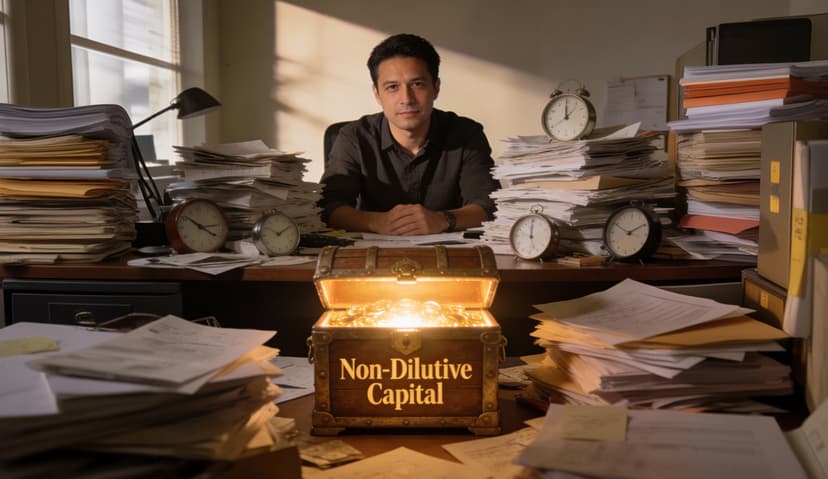
Everyone will tell you that winning a big government grant is like winning the lottery. Here's the secret: they're half right.
It is a lottery... if you only buy one ticket. Data from the National Cancer Institute shows paylines have dropped to the 4th percentile. That means your meticulously crafted, 100-hour proposal has the same odds as a Hail Mary. It gets wilder. An NSF report found that review panels considered "almost 70% of proposals 'equally meritorious'" before funding only a third of them. It's literally a coin flip at the finish line.
But what if you could stop playing the lottery and start building an investment portfolio? What if you could apply the same diversification principles that Ray Dalio uses to de-risk the entire process and systematically stack the odds in your favor for landing non-dilutive capital? Let's get into it.
Sound familiar? I bet it does. You're a deep tech founder, a builder. You live and breathe data, strategy, and execution. The idea of pinning your runway on what feels like a random roll of the dice just doesn't jive with how you operate. Yet, here we are.
The Grant Funding Casino: Welcome to the Hunger Games
The current grant landscape isn't just competitive; it's a full-on battle royale. The numbers are grim. The NIH, a titan of R&D funding, is projected to award thousands fewer research grants in FY25 compared to previous years. It's a shrinking pie with more people at the table.
This squeeze creates situations that feel completely absurd. Take the National Cancer Institute, where "paylines" -- the funding cutoff score -- have plummeted to a historic low of the 4th percentile. Think about that. Out of 100 brilliant, world-changing proposals, 96 of them go home with nothing. Not because they were bad ideas, but because the line had to be drawn somewhere.
And that's the part that feels so broken, right? Your idea is good. Your team is stellar. But so are dozens of others. As that NSF report highlights, when nearly 70% of submissions are deemed "equally meritorious," the final decision can feel totally arbitrary. It's not about being good; it's about being lucky on the day the decisions are made.
Imagine spending an average of 116 hours crafting a single NSF proposal -- that's nearly three full work weeks -- pouring your team's expertise and your company's vision onto the page, only for it to be one of many excellent-but-unfunded applications. How do you build a business plan around that?
You don't. You change the game.
So, if the game feels rigged, what's a savvy founder to do? My take: Stop buying lottery tickets.
Stop Buying Lottery Tickets. Start Building a Portfolio.
You wouldn't YOLO your entire 401k into a single meme stock, right? You'd diversify. You'd balance high-risk, high-reward plays with safer bets. You'd build a portfolio designed to weather market volatility and deliver consistent returns over time.
So why would you bet your startup's future -- its runway, its R&D milestones, its very existence -- on a single, long-shot grant application?
The move is to apply the same battle-tested principles of financial portfolio theory to your grant funding strategy. This isn't just a cute analogy; it's a strategic framework for turning a high-risk gamble into a manageable, data-informed investment process.
Diversification in grant seeking means spreading your efforts across different types of opportunities. Instead of going all-in on one massive NIH R01 grant, you build a portfolio that might include a large federal SBIR/STTR application, a couple of smaller state-level tech grants, an application to a private foundation that vibes with your mission, and maybe a corporate-sponsored research award.
Each "asset" in your portfolio has a different risk profile, timeline, and funding body. A rejection from one doesn't sink the entire ship. A win in any category extends your runway and provides validation. This is exactly how sophisticated organizations operate. Nonprofits, facing similar funding pressures, are increasingly expanding their grant portfolios and submitting more applications to bridge funding gaps. They're adapting to survive.
Now, this isn't about throwing spaghetti at the wall and hoping something sticks. Quality is paramount. This isn't a spray-and-pray strategy. The goal is to build a portfolio of high-quality applications. For well-crafted, highly-aligned proposals, success rates can still average around 70% with certain funders. The strategy is to have several of these high-quality "assets" in play simultaneously, which dramatically increases the probability that at least one of them pays off.
The Moneyball Approach to Grants
If you've seen the movie Moneyball, you know the story. The Oakland A's, a small-market baseball team, couldn't afford superstars. So, their general manager, Billy Beane, used statistical analysis to find undervalued players who, collectively, could win games. He stopped chasing home-run hitters and started building a team based on getting on base. He played the odds.
You can do the same with your grant strategy.
The data is clear: submitting a portfolio of 3-5 grant applications significantly improves your chances of success. The math is simple probability. If a single high-quality application has, say, a 20% chance of success, your odds of going 0-for-1 are 80%. But if you have three independent applications, each with a 20% chance, the probability of striking out on all three drops to 51% (0.8 x 0.8 x 0.8). You've nearly doubled your odds of getting at least one "yes." With five applications, the odds of a total shutout fall to just 33%.
You're using data to tilt the odds in your favor, even when it feels like you're playing against the house.
A powerful tactic here is to deconstruct a large, ambitious program into several smaller, impactful "project grants." Instead of asking one funder for $2 million to build your entire platform, you might approach three different funders with discrete, fundable components. For example, you could pitch a federal agency on a $750k proposal for the core technology development, while simultaneously pitching a private foundation on a $250k proposal for the ethical framework and community engagement piece, and a state-level group on a $100k pilot study within the local ecosystem.
This approach, recommended by grant strategists, allows you to submit to multiple donors simultaneously for the same overarching program. Each grant stands on its own merit, but together they build your vision. It's like assembling the Avengers of funding.
Here's where it gets wild: It's not just us saying this. Even the funders themselves are starting to admit the process is kinda random.
Deep Dive: What Happens When the House Admits the Game is Rigged?
If you think this portfolio idea sounds like a clever hack, you should see what the funders are doing. Faced with the "equally meritorious" problem, some of the world's most forward-thinking funding bodies have started doing something radical: they're introducing lotteries.
That's right. They are literally rolling the dice.
This isn't a joke. It's a formal process called "partial lotteries" or "focal randomisation." The process works like this: proposals are reviewed and scored as usual. All the applications that meet a high bar of excellence -- that "equally meritorious" group -- are then put into a pool, and the winners are chosen at random.
The pioneer of this is the New Zealand Health Research Council's Explorer Grant, which has used this method since 2013 to fund transformative and unconventional research. And what did the scientists think? A study found that 63% of applicants agreed it was an acceptable method for making funding decisions. They preferred an honest lottery to the illusion of perfect, objective selection among a group of stellar proposals.
This is the ultimate validation of the portfolio strategy. When the house itself admits that, at the highest level, the game is one of chance, the only rational response for a player is to get more high-quality tickets into the draw. If your proposal is good enough to make it into the lottery pool, your work is done. The rest is probability. Your job is to maximize the number of high-quality entries you can get into these final rounds across different agencies.
Building Your Grant Flywheel
Let's be real. Managing one grant application is a heavy lift. Managing five sounds impossible. But it's not about working 5x harder; it's about working smarter by building a repeatable system.
Think of it like a playbook. The first time you run a new play, it's clunky. By the fifth time, it's muscle memory.
Building a grant portfolio relies on creating reusable assets and a centralized process. This means developing a "master narrative" -- a core document containing the essential elements of your company's story, technology, team, and impact. When a new grant opportunity arises, you're not starting from scratch. You're adapting and tailoring proven components, which dramatically reduces the activation energy for each new application.
The key is organization. Smart teams use centralized grant management systems or even a robust master spreadsheet to track deadlines, requirements, and communications for each opportunity. This isn't about adding more work; it's about creating a single source of truth that prevents chaos and duplicated effort. It transforms the ad-hoc, frantic process of grant writing into a predictable, manageable function of the business -- just like sales, marketing, or product development.
From Gambler to Investor
The grant funding game is tough, but it's not a pure lottery. It's a game of skill and probability. Your skill gets you to the final table. A smart strategy is what lets you win the pot.
Relying on a single, all-or-nothing grant application is treating your company's future like a lottery ticket. It's a strategy based on hope. And hope is not a strategy.
By shifting your mindset from a gambler to an investor, you take back control. You stop chasing a single jackpot and start building a diversified portfolio of high-quality, non-dilutive funding opportunities. You use data to your advantage, de-risk the process, and create a sustainable, repeatable engine for growth.
With a strategic, data-informed portfolio approach, you can stop crossing your fingers and start building a more predictable, resilient path to securing the capital you need to change the world. Go get 'em.
Ready to build your grant roadmap?
We've written hundreds of proposals across 30+ agencies. Our Strategy Review gives you a straight answer on whether grants fit your startup.
Claim Your Free Strategy Review